
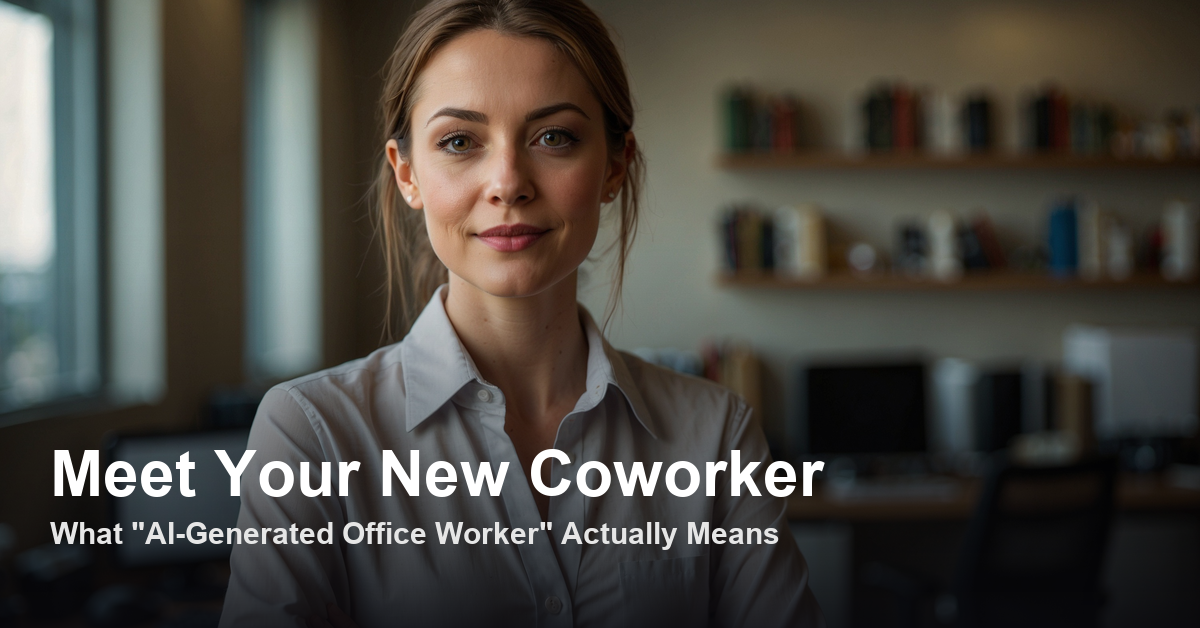

Scroll through enough LinkedIn ads, SaaS landing pages, or corporate stock photography lately and you’ll start noticing something off. The person smiling in the blazer, headset on, laptop open to a suspiciously clean dashboard doesn’t work anywhere. They never have. They’re an AI-generated office worker, and at this point they’ve probably shown up in more pitch decks than most actual employees.
We got curious about this trend, partly because we’ve quietly used a version of it ourselves. More on that below.
Why Brands Reach for an AI-Generated Office Worker Instead of a Real One
The pitch is simple. No photographer, no model release, no awkward half-day shoot where someone has to pretend to be thrilled about a spreadsheet. Type a prompt, get a photorealistic “employee” in whatever setting, outfit, or ethnicity mix your brand guidelines call for. It’s fast, it’s cheap, and it scales. Need the same “team” in five different marketing variants? Generate five more.
For small businesses especially, that’s a real draw. Professional photography is expensive and logistically annoying. An AI-generated stand-in gets you 80% of the polish for a fraction of the cost and none of the scheduling headache.
How to Spot One
The tech has gotten good, but it’s not flawless yet. A few tells that still show up more often than the AI companies would like:
- Hands. Still the classic giveaway. Extra fingers, fingers that bend wrong, a hand half-merged into a coffee mug.
- Too-perfect symmetry. Real faces are slightly asymmetric. AI faces often aren’t, which reads as subtly “off” even when you can’t articulate why.
- Background text and objects. Look at the whiteboard, the monitor, the badge lanyard. Text often dissolves into gibberish the moment it’s not the main subject.
- Skin that’s a little too smooth, hair that’s a little too consistent. Real skin has texture. Real hair has flyaways. AI renders tend to average that out.
If you want a fuller field guide, CanIPhish’s breakdown of eight AI-image tells covers a few more we didn’t get into here, like dental oddities and clothing that doesn’t quite construct logically.
Is It Deceptive?
This is the part that gets genuinely debated. Nobody’s clutching pearls over stock photography. We’ve always known “the smiling woman on the pamphlet” wasn’t a real customer. But there’s a difference between a stock photo of a real person who consented to be photographed, and a synthetic face that exists purely because a model was told to generate one. Some brands now disclose AI imagery outright, most don’t, and there’s no legal requirement forcing them to yet. Our take: it’s not inherently dishonest, but it’s worth a brand being upfront about it if the image is meant to represent something specific, like “our team” or “a real customer.”
Our Own AI-Generated Office Worker Photos
Full disclosure: some of the imagery on this very site already leans on the same trick. A few “people” featured across our pages are AI-generated, not staff photos. It’s a practical call more than a philosophical one. It let us put a friendly face on the page without pulling someone away from actual work for a photoshoot.
Making a convincing one isn’t hard. A decent design tool and a specific-enough prompt (lighting, pose, setting, wardrobe) gets you most of the way there in a couple of tries. The harder part is the same thing that trips up every AI image: getting it to look like a specific, believable individual rather than a slightly uncanny composite of “office worker” as a concept.
Where This Is Headed
As the tooling keeps improving, the tells above are going to keep getting harder to spot. That probably means the more interesting question in a year or two won’t be “can you tell it’s fake,” but “does the brand tell you it’s fake,” and whether audiences start expecting that disclosure the way they now expect to see “#ad” on a sponsored post.
For now, next time a suspiciously friendly face is smiling at you from a pricing page, take a closer look at the hands. And if you’re more curious about where AI is actually earning its keep in the workplace rather than just posing for stock photos of it, we broke that down in Stop Building Chatbots. Start Building an AI Employee.