
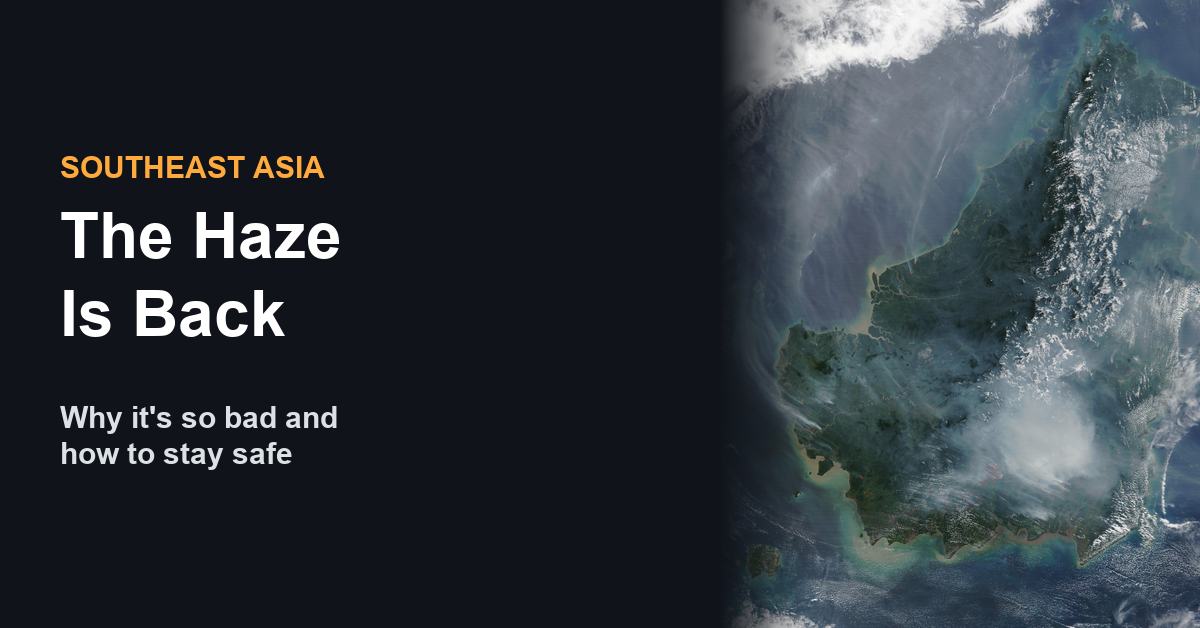

If your eyes are stinging and the skyline looks like someone smeared Vaseline on it, you’re not imagining things. The haze is back across Southeast Asia, and this year it’s a bad one.
The latest (6–9 October)
- Singapore: On 6 Oct at 6am, the 24-hour PSI was in the unhealthy band (101+) in four of five regions: north 107, east 112, west 117, central 130. Only the south stayed moderate at 95. Wikipedia’s page on the 2026 haze lists Central Singapore hitting a PSI of 186 at 2pm on 9 Oct, the highest this year. We couldn’t confirm that figure from a second source, so check haze.gov.sg for the live number.
- Malaysia: The Johor Regent ordered all Johor schools closed on 8–9 Oct, affecting about 617,000 students in 1,198 schools. Al Jazeera reports schools in KL, Putrajaya, Johor, Malacca, Negeri Sembilan, Pahang and Selangor were ordered shut on 9 Oct. The Star has the list of states.
- Indonesia: Satellites picked up 21,708 hotspots on 6 Oct, up from 11,100 on 1 Oct. Central Kalimantan led with 7,384. (Hotspots are heat detections that may be fires, not confirmed fires.)
- How long? Indonesian authorities have warned the fires could continue through October or early November. Some Malaysian reports expected relief from around 9 Oct as the inter-monsoon period begins, but Singapore’s readings were still climbing that day. Don’t count on it clearing overnight. (We covered an earlier regional episode in Thailand air pollution hits disastrous levels.)
Why is it so bad this year?
- A strong El Niño plus a positive Indian Ocean Dipole. Both bring drought to the region. ASEAN’s weather centre reported hotspot numbers up around 86% on last year.
- People set the fires. Most fires are lit to clear land for plantations and farms. Indonesia’s president has called slash-and-burn “ecological terrorism” and promised zero tolerance, per Wikipedia, which also lists 219 police investigations and 162 named suspects.
- Peat. Drained peatland can smoulder underground for weeks and reignite after the surface flames look out, which makes the smoke thick and long-lasting.
- No rain. Without rain, fires are harder to put out, the haze isn’t washed from the air, and cloud seeding is less effective (TIME).
- Weak enforcement across borders. The 2002 ASEAN haze agreement requires monitoring and information sharing but has no real sanctions. The smoke doesn’t care about borders, and this year it has reached as far as the Philippines.
How bad is “bad”?
- Indonesia’s worst wildfires in 11 years, per TIME.
- 202,000 hectares burned from January to July (government data, via TIME). Environmental group YKAN estimates about 600,000 hectares in August alone.
- Singapore had all five regions unhealthy at the same time on 15 Sep, the first time since 2019.
- A CREA study cited by Wikipedia links more than 1,700 deaths to fire-related pollution. We couldn’t verify this independently, so treat it as an estimate.
PSI vs PM2.5: which number should you look at?
- 24-hour PSI is for planning tomorrow. It’s an average over the last day.
- 1-hour PM2.5 is for deciding right now, such as whether to go for a run. It moves faster. (NEA explains the difference on haze.gov.sg.)
- PSI bands: 0–50 good, 51–100 moderate, 101–200 unhealthy, 201–300 very unhealthy, 300+ hazardous.
Practical tips
These are general health precautions, not medical advice. For official guidance, see NEA and MOH.
When PSI is unhealthy (101+):
– Cut down on prolonged or strenuous outdoor activity. Move workouts indoors or skip them.
– Keep windows and doors closed. Use air-con on recirculate if you have it.
– If you must go out, wear an N95 (or equivalent) mask that fits snugly. Ordinary surgical masks and cloth masks do little against fine smoke particles.
– Drink water and rinse irritated eyes with clean water or saline eye drops.
Higher-risk groups should be extra careful: children, older folks, pregnant women, and anyone with asthma, COPD, or heart conditions. Keep medication handy, and see a doctor if symptoms worsen (persistent cough, wheezing, chest tightness, shortness of breath).
At home:
– Use an air purifier with a HEPA filter in the room you spend the most time in, such as the bedroom. Keep the door closed so it’s cleaning a small space.
– Don’t make indoor air worse: skip incense, candles and smoky frying. Wet-wipe surfaces rather than sweeping dust back into the air.
– Haze season clogs filters faster than usual, so replace them on schedule.
Planning your day:
– Check haze.gov.sg or the myENV app each morning for the 24-hour PSI and the 1-hour PM2.5.
– Have a few masks and spare purifier filters at home before the next spike. They sell out fast.
– If your kids’ school or your workplace has haze guidelines, know them in advance.
The bottom line
This isn’t a one-day blip. With the fires still burning and the dry spell stretching on, expect on-and-off bad air for the next few weeks. Check the numbers daily, keep a stock of N95s, and look after the vulnerable people at home.
Sources
- 2026 Southeast Asian haze, Wikipedia
- Why Southeast Asia Is Facing a Haze Crisis, TIME, 17 Sep 2026
- Haze: All Johor schools to close for two days, Malay Mail, 7 Oct 2026
- Malaysia shuts schools as haze from Indonesian fires chokes Southeast Asia, Al Jazeera, 9 Oct 2026
- Haze: Schools in five states, FT to close on Oct 9, The Star, 8 Oct 2026
- Haze in Singapore: Air quality remains unhealthy for much of the island, ASEAN News Network
- How worrying is Singapore’s haze outlook, and how can you protect yourself?, ASEAN News Network
- ASEAN hotspot count surges to 86 percent as El Niño raises haze concerns, ASEAN News Network
- Asean haze controls face tougher climate test as smoke crosses borders, Eco-Business
- Ministry of Forestry hotspot counts via Katadata: 1 Oct, 6 Oct
- Live readings: haze.gov.sg (NEA)