
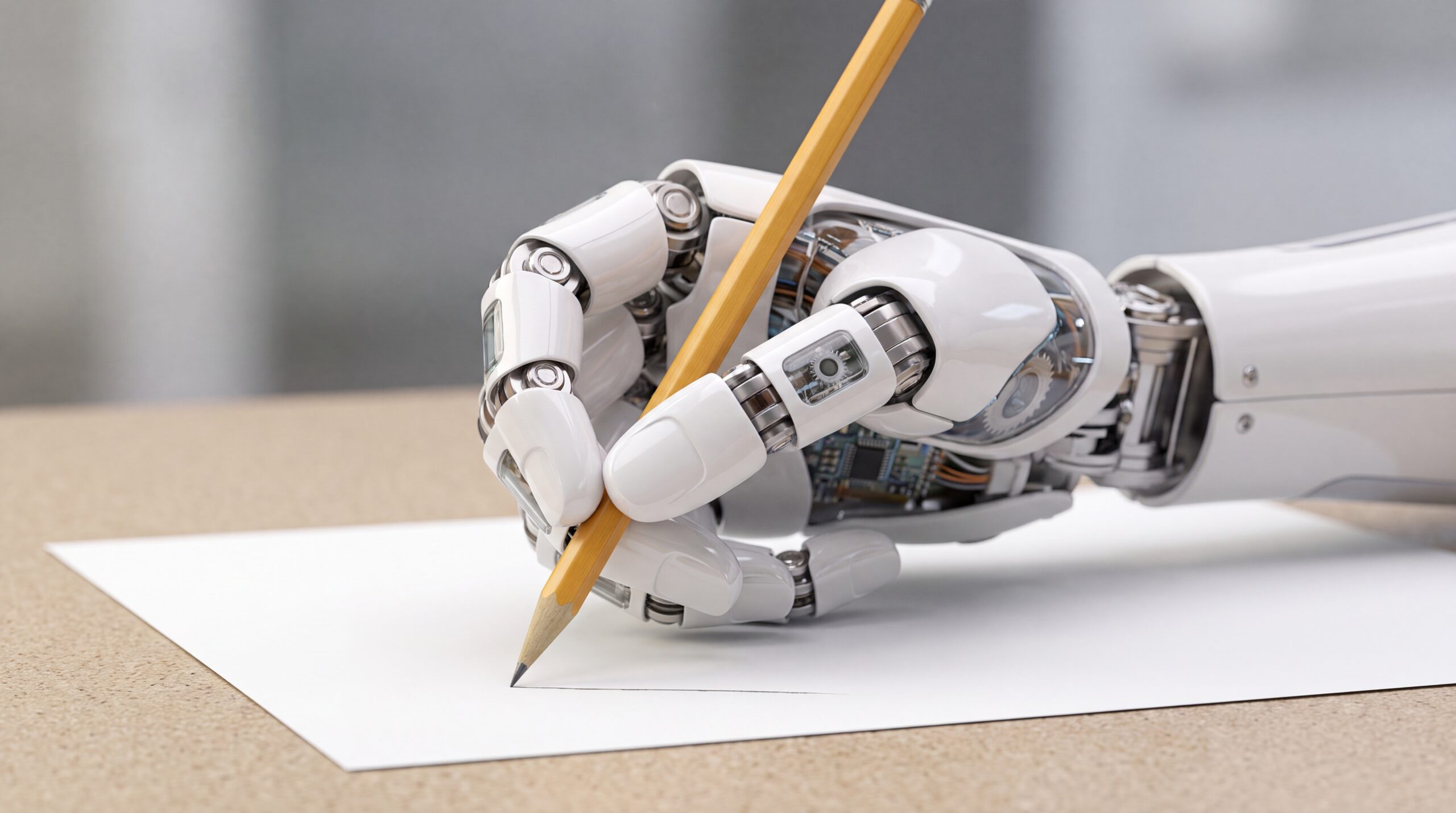

So the AI That Might Be Writing Your Next Blog Post Now Comes With a Snitch Built In
AI watermark. Two words that are about to make life a little more complicated for anyone trying to pass off machine-written text as their own. Quick disclosure before we go any further: this post was written with Claude. Which is a little awkward, because the thing we’re about to talk about is Anthropic — the company behind Claude — quietly baking an invisible AI watermark into everything Claude writes. So somewhere in this article, statistically speaking, there’s a tag on these words that says “yep, a machine did some of this.” We just don’t know exactly where. That’s kind of the point.
So what is this AI watermark, exactly?
Anthropic announced that newer Claude models now stamp their text output with a watermark you can’t see, hear, or copy-paste around — at least not easily. It doesn’t change a single word of what you read. No weird spacing, no secret font tricks, nothing your eyes would catch. It’s baked into the pattern of the writing itself, and it’s designed to survive a plain copy-paste into an email, an essay, or — hypothetically — a blog post. Anthropic isn’t calling it a gimmick either: this AI watermark is meant to be a real, checkable signal, not just a policy promise.
The rollout covers pretty much everywhere Claude shows up: the consumer app, the API developers build on, Claude Code, Claude Cowork, even the versions of Claude running through AWS, Google Cloud, and Microsoft’s cloud. If a model launched on or after August 2, it’s watermarking by default. Older models are reportedly getting the feature backported.
Why now?
Short answer: the EU. The AI Act requires this kind of disclosure for AI-generated content, and Anthropic decided the cleanest way to comply was to just turn it on everywhere, not carve out a special EU-only version. Which, credit where it’s due, is a less annoying approach than most companies take with region-locked compliance features.
The bigger picture is the flood of “AI slop” — the low-effort, mass-produced junk content clogging up search results, social feeds, and inboxes. A verifiable AI watermark gives platforms, teachers, and readers an actual tool to check whether something was machine-written, instead of squinting at text and guessing based on vibes and an overuse of the word “delve.” It won’t stop the flood on its own, but it at least gives everyone downstream a way to ask the question with some evidence behind it.
Okay but does it actually work?
Here’s the catch, and it’s a real one: the watermark is fragile. Paraphrase the text, translate it, run it through another AI, or heavily edit it, and the watermark can disappear entirely. Mix AI output with your own writing and the signal gets muddy fast. Anthropic has also been upfront that finding a watermark doesn’t prove Claude wrote something start to finish — even a light proofread or a quick translation pass can leave a trace on text a human wrote every word of.
So this isn’t a lie detector. It’s more like a smoke alarm that goes off for smoke but shrugs at a well-hidden fire. Useful, but not the last word — as Fortune put it, “watermarking alone isn’t going to clean up the internet.”
The part that made us laugh
We asked Claude to help write a post about Claude watermarking its own writing, and it did — cheerfully, self-awarely, and probably with an invisible tag somewhere in these paragraphs proving it. There’s something very 2026 about that. The tool announcing “you’ll be able to tell when I’ve been used” got used to write the announcement about itself.
Anthropic says third-party detection tools are coming, so eventually anyone will be able to check for that AI watermark themselves, no special access required. Until then, consider this post exhibit A: partly human-edited, partly machine-drafted, and — if the tech works as advertised — quietly signed by its non-human co-writer the whole time.
Whether that’s reassuring or slightly unsettling probably depends on how much AI-written text you’ve already read this week without knowing it. Either way, the era of “I can’t prove it, but it feels AI-written” might be quietly coming to an end — replaced by an actual, checkable AI watermark instead of a hunch.